

So, you’ve decided to pick up the guitar. Congratulations! You’re joining a lineage that stretches from ancient lutes to the digital-hybrid rigs. Whether you want to lead a campfire singalong or shred in a virtual stadium, the first few weeks are the most critical - and, let’s be honest, the most frustrating.
In the past, you’d have to find a local teacher or sift through thousands of contradictory YouTube videos. Today, the game has changed. One of the most effective ways to bridge the gap between "I own a guitar" and "I can play a song" is to use an AI Chat assistant as your personalized theory coach. Think of it as having a music professor in your pocket. While a video can't hear you, an AI Chat can answer hyper-specific questions like, "Why does my C-Major chord sound muffled?" or "Can you create a 10-minute practice plan for someone with small hands?" We recommend use https://cabina.ai/tools/ai-chat AI to supplement your practice helps you bypass the "information overload" that causes most beginners to quit within the first month.
Choosing Your Weapon: Acoustic or Electric?
The "acoustic vs. electric" debate is simpler than ever. There's a common myth that you must start on an acoustic to "build finger strength." Let’s correct that: start with the guitar that excites you most. If you love Metallica, an acoustic might bore you. If you love Taylor Swift, an electric might feel too sterile.
| Feature | Acoustic Guitar | Electric Guitar |
|---|---|---|
| Portability | High (no cables needed) | Low (needs amp/interface) |
| Finger Pain | Higher (thicker strings) | Lower (thin, light strings) |
| Sound Variety | Natural, warm | Infinite (with apps/pedals) |
| Volume Control | Low (it's always loud) | High (headphones-friendly) |
Anatomy of the Instrument
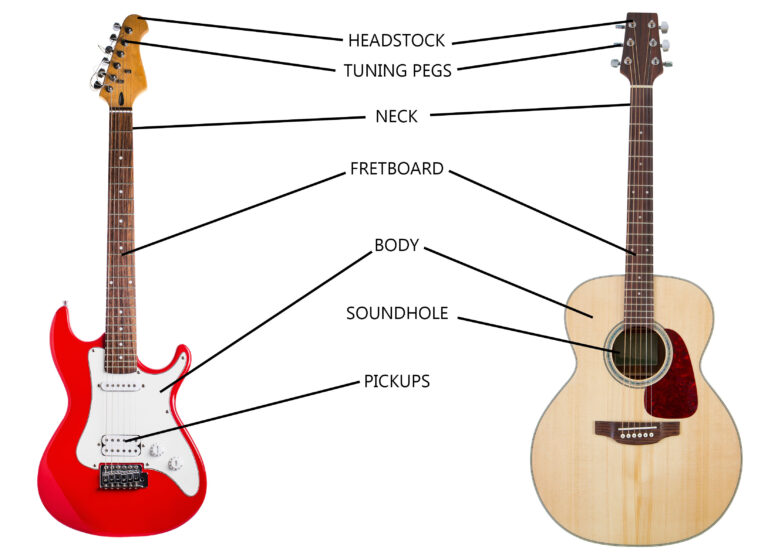
Before you play, you need to know the "parts of the car."
-
The Headstock: Where the tuning pegs live.
-
The Neck: The long part where your hand moves.
-
The Fretboard: The front of the neck, divided by metal strips called frets.
-
The Body: Where the sound resonates.
-
The Strings: Six of them, numbered 1 to 6 (thinnest to thickest).
Tuning: The Non-Negotiable Step
A guitar out of tune is a piece of furniture, not an instrument. In standard tuning, the strings are:
E – A – D – G – B – e
(Mnemonic: Every Amateur Does Get Better eventually)
Use a clip-on tuner or a phone app. Do not skip this. Even the best players in the world check their tuning every 15 minutes.
Posture: Don't Fight the Wood
Most beginners struggle because they are holding the guitar in a way that creates tension.
-
The Thumb: Keep it on the back of the neck, roughly in the middle. Do not "baseball grip" the neck yet; it limits your reach.
-
Arch Your Fingers: You want to press the strings with the very tips of your fingers. If your fingers are flat, they will accidentally mute the other strings (a phenomenon known as "fretting buzz").
-
Relax Your Shoulders: If you’re tensing up, your muscles will fatigue in minutes. Take a breath.
Your First Chords: The "Big Four"
You can play roughly 40% of all popular music with just these four chords. When you look at a chord diagram, remember: your index finger is 1, middle is 2, ring is 3, and pinky is 4.
The Beginner’s Essentials
-
E Minor (Em): The easiest chord. Only two fingers on the 2nd fret.
-
G Major: The king of chords. It sounds big, bright, and full.
-
C Major: A bit of a stretch, but essential for folk and pop.
-
D Major: Formed like a small triangle on the bottom three strings.
Pro Tip: When switching between chords, look for "anchor fingers" - fingers that stay on the same string or fret during a transition. Keeping an anchor finger down makes your transitions 2x faster.
Reading Guitar TABs
Standard musical notation (the "dots on lines") is great, but most guitarists use TAB (Tablature). It’s a visual map of the fretboard.
-
The six lines represent the six strings. The bottom line is the thickest string (Low E).
-
The numbers tell you which fret to press. A "0" means play the string open (no fingers).
-
Vertical Alignment: If numbers are stacked on top of each other, play them at the same time (that’s a chord).
The Rhythm Secret: The "Pendulum"
Beginners often focus 90% of their energy on their left hand (the fretting hand). But your right hand (the strumming hand) is the "drummer."
The Golden Rule of Strumming: Keep your hand moving up and down like a pendulum, even when you aren't hitting the strings. This keeps your internal clock steady.
-
Downstrums usually happen on the beat (1, 2, 3, 4).
-
Upstrums usually happen on the "and" (the halfway point between beats).
Common Beginner Pitfalls (And How to Fix Them)
Learning guitar isn't about talent; it's about avoiding the things that make you want to put the guitar in the closet forever.
-
"My fingers hurt too much!" This is normal. We still haven't evolved past skin sensitivity. Practice for 10 minutes, three times a day, rather than one 30-minute session. Your calluses will form in about 10 days.
-
The "Buzzing" Sound: Usually caused by not pressing close enough to the fret wire. Move your finger slightly closer to the metal strip (without being on top of it).
-
"My hands are too small." Unless you are literally four years old, your hands are fine. Django Reinhardt played world-class jazz with only two functional fingers. It's a matter of technique, not span.
Your 7-Day "Quick Start" Roadmap
Consistency beats intensity every single time. Here is your first-week mission:
| Day | Goal |
|---|---|
| Day 1 | Learn to tune and memorize string names. |
| Day 2 | Play the Em and G chords until they sound clear. |
| Day 3 | Practice switching between Em and G for 5 minutes. |
| Day 4 | Learn the C and D chords. |
| Day 5 | Practice a basic "Down, Down-Up" strumming pattern. |
| Day 6 | Try to play the 4-chord progression: G - D - Em - C. |
| Day 7 | Find a 3-chord song you love and try to play along to the chorus. |
Guitar is a lifelong journey, but the "entry fee" is just a bit of patience and a few sore fingertips. By leveraging modern tools like AI Chat for theory and staying consistent with your "Big Four" chords, you'll be playing full songs faster than any generation before you.
The most important thing? Don't wait until you're "good" to have fun. Play the one riff you know as loud as you can. That's what the guitar was made for.


